This blog has moved to www.mscroggs.co.uk.

Monday, 3 March 2014

Sunday Afternoon Maths II Answers & Extensions

This post contains the answers to this week's Sunday Afternoon Maths and some extension problems based around the originals.

Guess the Diagonal

CG is equal to AF as they are both diagonals in a rectangle.
AF is a radius of the triangle, so AF = 10.
Therefore CG = 10.
Extension
Calculate the lengths of CI and CJ.

Calculate the length of HG.

Sunday, 2 March 2014

Sunday Afternoon Maths II

Here's this week's collection. Solutions will be posted on Monday.

Guess the Daigonal

Calculate the length of the diagonal CG.

Monday, 24 February 2014

Sunday Afternoon Maths I Answers & Extensions

This post contains the answers to this week's Sunday Afternoon Maths and some extension problems based around the originals.

Burning Ropes

Light one rope at both ends and the other at one end. When the first rope finishes burning, light the other end of the second rope. The second rope will finish burning 45 minutes after the start.
Extension
What are all the possible times you can measure with two ropes? How about three ropes? Four ropes? n ropes?

Pole Position

The two poles can be any distance apart; the distance does not affect the heights.
Extension
If the heights of the two poles were 12m and 24m tall, what height would the intersection of the lines be?
If the heights of the two poles were am and bm tall, what height would the intersection of the lines be?

Circles

Call the blue area B and the red area R.
R = Area of quarter circle - Area of semicircle - (Area of semicircle - B)
R = ¼π(2r)2 - ½πr2 - (½πr2 - B)
R = πr2 - ½πr2 - ½πr2 + B
R = 0 + B
R = B
Extension
Prove that the red and blue areas are equal.

Pyramid and Tetrahedron

Let the length of a side of a triangle be 2L (I used 2L and not L to get rid of fractions in the calculations).
By Pythagoras' Theorem, the height of a triangle is L√3.
Using Pythagoras' Theorem again, the height of the square-based pyramid is L√2.
Therefore, the volume of the square-based pyramid is ⅓×(2L)2×L√2.
This simplifies to 4/3√2L3.

Next, we find the area of the tetrahedron.
Call the point on the base of the tetrahedron, directly below the vertex at the top A.
Using cosine in the triangle made by A, the corner of the base and the midpoint of a side of the base, the distance from the corner to A is 2/√3L.
Using Pythagoras' Theorem yet again, we find that the height of the tetrahedron is L2√2/√3
Therefore, the volume of the tetrahedron is ⅓×½×2L×L√3×L2√2/√3.
This simplifies to 2/3√2L3.

Finally, the ratio of volume of the square based pyramid to the tetrahedron is:
4/3√2L3 : 2/3√2L3
2 : 1
Extension
What would the ratio be if they were isosceles triangles?

8! minutes

8×7×6×5×4×3×2×1 minutes
  = 8×7×4×3×1 hours (dividing by 60)
  = 7×4×1 days (dividing by 24)
  = 4×1 weeks (dividing by 7)
  = 4 weeks
Extension
8 is the smallest number n such that n! minutes is a whole number of weeks.
What is the smallest number m such that m! seconds is a whole number of weeks?

Sunday, 23 February 2014

Sunday Afternoon Maths I

Following some relatively popular Twitter posting of maths problems, I've decided to start posting a weekly collection of interesting puzzles I have encountered. I'll be posting solutions on the following Monday.
Here's this week's collection, including puzzles from this month's MathsJam:

Burning Ropes

You have two ropes and some matches. Each rope, if lit at its end, will burn for 60 minutes. But the rate of burning is not regular, so cutting a rope in half doesn’t result in a burn time of 30 minutes. How can you use the ropes to time exactly 45 minutes?

Pole Position

Two poles stand vertically on level ground. One is 10 feet tall, the other 15 feet tall. If a line is drawn from the top of each pole to the bottom of the other, the two lines intersect at a point 6 feet above the ground. What’s the distance between the poles?

Circles

There is a quarter circle with radius 2r and centre A and two semi circles with radius r and centres B and C.
Prove that the red area is equal to the blue area.

Pyramid and Tetrahedron

If four equal equilateral triangles form the sides of a square-based pyramid, what is the ratio of the volume of the pyramid to the volume of the tetrahedron whose sides are the four triangles?

8! minutes

How many weeks are there in 8! (8×7×6×5×4×3×2×1) minutes?

Monday, 23 December 2013

Assorted Christmaths

Here is a collection of Christmas relates mathematical activities.

Flexagons

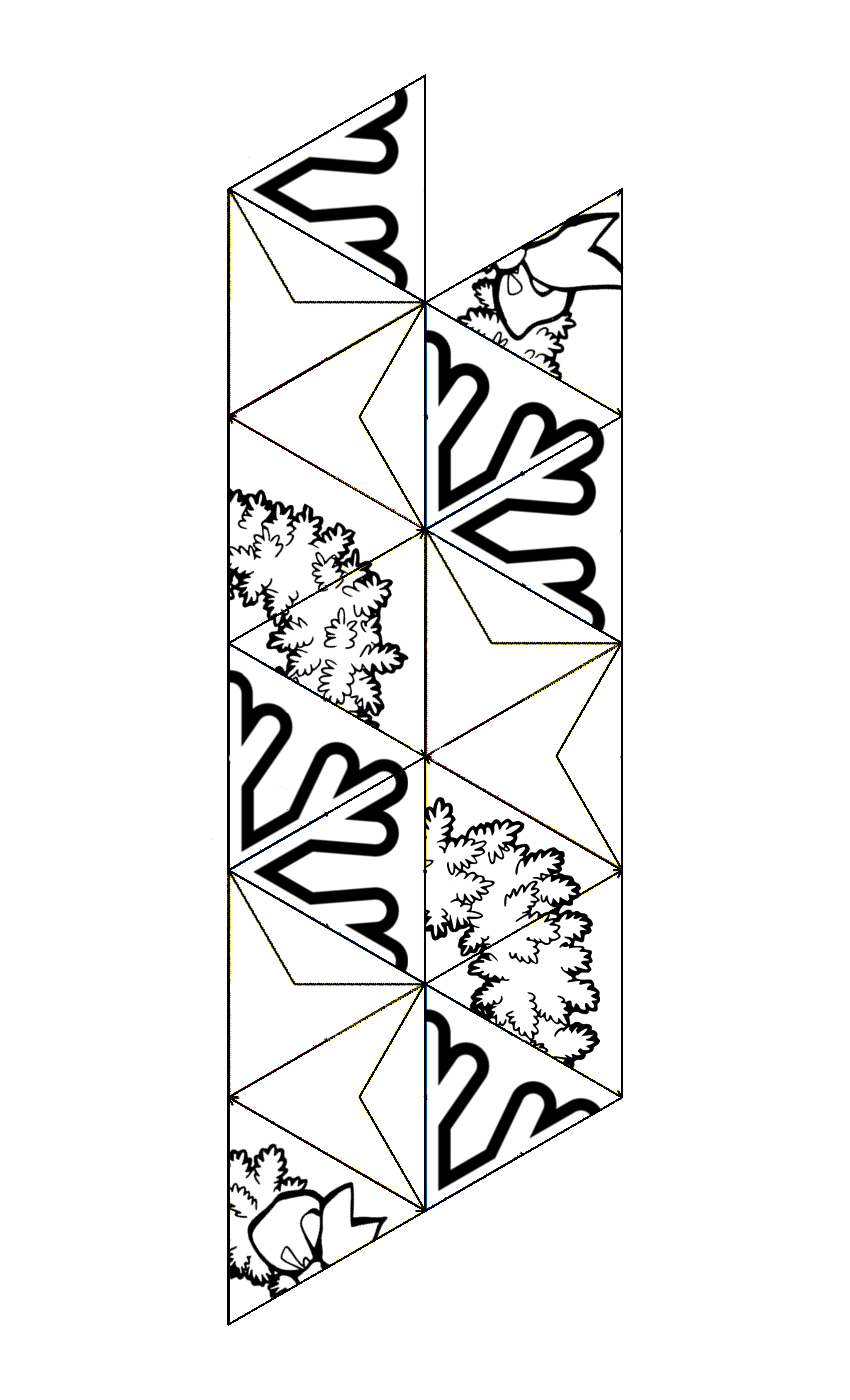
I first encountered flexagons sometime around October 2012. Soon after, we used this template to make them at school with year 11 classes who had just taken GCSE papers as a fun but mathematical activity. The students loved them. This lead me to adapt the template for Christmas:
And here is an uncoloured version of the template on that site if you'd like to colour it yourself and a blank one if you'd like to make your own patterns:
The excitement of flexagons does not end there. There are templates around for six faced flexagons and while writing this piece, I found this page with templates for a great number of flexagons. In addition, there is a fantastic article by Martin Gardner and a two part video by Vi Hart.

Fröbel Stars

I discovered the Fröbel star while searching for a picture to be the Wikipedia Maths Portal picture of the month for December 2013. I quickly found these very good instructions for making the star, although it proved very fiddly to make with paper I had cut myself. I bought some 50mm quilling paper which made their construction much easier. With a piece of thread through the middle, Fröbel starts make brilliant tree decorations.

Sunday, 15 December 2013

Pointless Probability

Last week, I was watching Pointless and began wondering how likely it is that a show features four new teams.
On the show, teams are given two chances to get to the final—if they are knocked out before the final round on their first appearance, then they return the following episode. In all the following, I assumed that there was an equal chance of all teams winning.
If there are four new teams on a episode, then one of these will win and not return and the other three will return. Therefore the next episode will have one new team (with probability 1). If there are three new teams on an episode: one of the new teams could win, meaning two teams return and two new teams on the next episode (with probability 3/4); or the returning team could win, meaning that there would only one new team on the next episode. These probabilities, and those for other numbers of teams are shown in the table below:
 No of new teams today
Noof new teams tomorrow
  1234
1001
4
1
201
2
3
4
0
33
4
1
2
00
41
4
000
Call the probability of an episode having one, two, three or four new teams P1, P2, P3 and P4 respectively. After a few episodes, the following must be satisfied:
P1 = 1P3 + P4
4
P2 = 1P2 + 3P3
24
P3 = 3P3 + 1P4
42
P4 = 1P1
4
And the total probability must be one:
P1 + P2 + P3 + P4 = 1
These simultaneous equations can be solved to find that:
P1 =  4 
35
P2 = 18
35
P3 = 12
35
P4 =  1 
35
So the probability that all the teams on an episode of Pointless are new is one in 35, meaning that once in every 35 episodes we should expect to see all new teams.
Edit: This blog answered the same question in a slightly different way before I got here.

Saturday, 30 November 2013

Rose & Crown, pt. 3

Way back in February*, I went with Jamie to see Dick Gaughan, the Scottish folk musician at Walthamstow Folk Club. When I got there, I found, to my surprise that the pub was a Rose & Crown!

Ye Olde Rose & Crown #3
Hoe Street, Walthamstow, London
3rd February 2013
Beer: 9/10
Service: 9/10
Atmosphere: 10/10
The pub had a nice interior, where we bought a pint each before ascending up a small rickety staircase to the room where the folk club was to be held.
The night began with some questionable singing from the landlord's family and friends, before Dick took the stage. Jamie had given me a copy of Handful of Earth for my birthday a few years before, but it was not until this evening that I truly appreciated how great a guitar player and singer Dick Gaughan is.
This pub really came close to being as great fun as the Rose & Crown in Oxford, although this was largely due to the musical entertainment, so viewed solely as a drinking hole, the great palace on North Parade remains undefeated...
*Through forgetfulness and laziness I'm only writing this up now.